The Power of Compressed Air:
Unlocking The Hidden Utility Fueling Industrial Performance
Imagine stepping onto your plant floor and noticing something different: no hiss of escaping air, full visibility into every compressor, and energy costs trending down. That’s not a dream—it’s what AIRpipe delivers. In industrial facilities, compressed air is essential but often unmanaged. AIRpipe changes that by making the invisible visible, giving teams control, clarity, and confidence.
What Makes AIRpipe Different:
Smart, Scalable, and Audit-Ready
Compressed air systems are often treated as static infrastructure. AIRpipe transforms them into dynamic, intelligent networks:
- Real-Time Monitoring – Sensors track performance and flag anomalies instantly
- Predictive Maintenance -Health scores forecast wear and service needs before failures occur
- Modular Scalability- Expand capabilities without costly retrofits
- Audit-Ready Dashboards- Performance and compliance reporting at your fingertips
- Smarter Fittings- Clamp-on designs reduce install time and improve moisture control
AIRpipe isn’t just a product—it’s a platform for compressed air mastery.
Compressed Air 101:
Why It’s the Fourth Utility and often the Least Understood
Compressed air powers everything from pneumatic tools to packaging lines. It’s clean, versatile, and essential—but also one of the most energy-intensive utilities in your facility. Despite its importance, most plants lack real-time visibility, relying on manual checks and reactive maintenance.
Anatomy of a Compressed Air System:
Compressed Air Components That Make or Break Performance
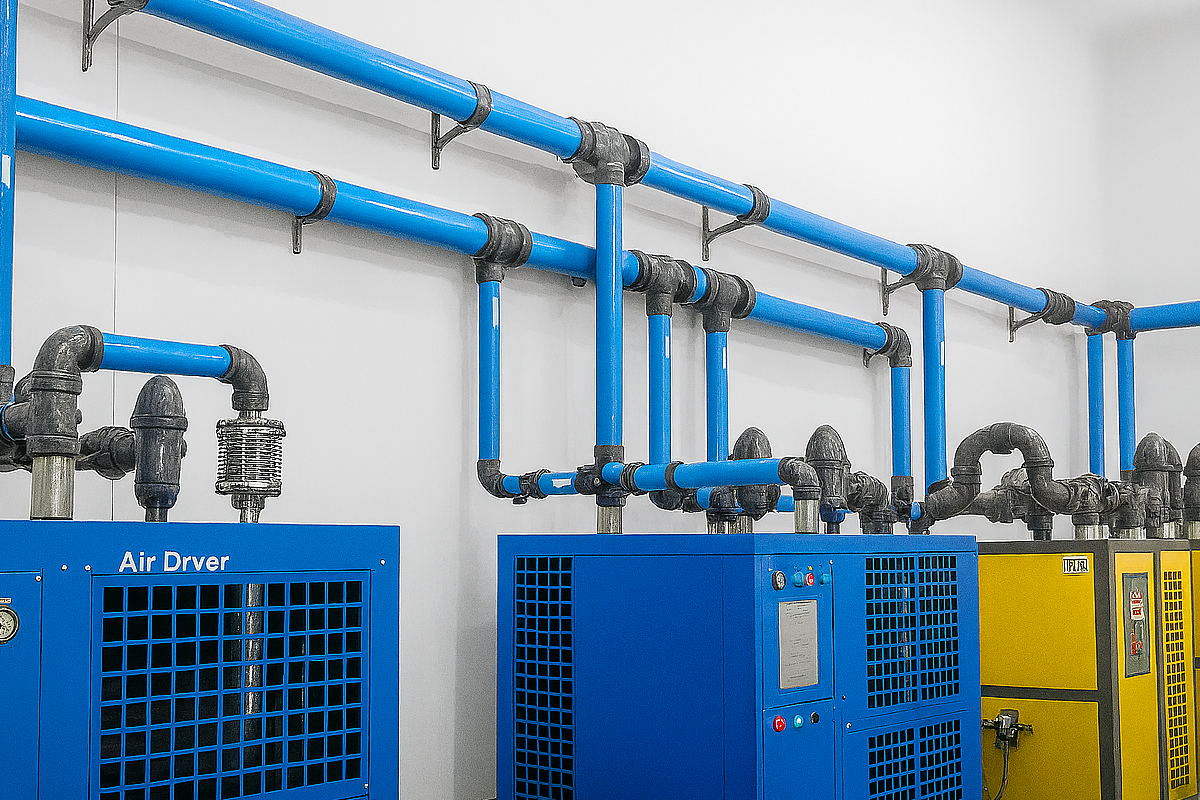
A compressed air system is more than just a compressor. It’s a coordinated set of components, each with a role in efficiency and reliability:
- Air Intake Filter – Captures airborne particles before they reach the compressor
- Air Compressor – Converts power into pressurized air
- Aftercooler – Cools discharged air and lubricant
- Air Receiver – Stabilizes pressure during demand spikes
- Air Dryer – Removes moisture to protect downstream equipment
AIRpipe enhances each link in this chain—especially where traditional systems fall short.
Moisture Management:
Engineered to Protect Systems From Silent Damage
Moisture is inevitable—but damage isn’t. AIRpipe’s drop legs, smart fittings, and integrated dryers prevent corrosion, fouling, and product contamination.
Example:
- 1 m³ of air at 77°F and 60% RH holds 13.8g of water
- After compression to 7 bar(g), it can only hold 4.95g
- Result: 8.85g of water condenses out
AIRpipe’s design ensures that moisture is captured, drained, and never allowed to compromise your system.
Designing Smarter Compressed Air Systems:
Layouts, Flow, and Diagnostics
A well-designed compressed air system isn’t just about the compressor—it’s about how air moves, how it’s treated, and how it’s used. AIRpipe supports strategic system design with three design principles that separate reactive systems from strategic ones:
- Looped Header Layouts – Ensure consistent pressure and reduce dead zones
- Drop Legs with Drain Points – Prevent moisture from reaching tools and equipment
- Flow Meters and Pressure Sensors – Enable real-time diagnostics and optimization
These design choices don’t just improve performance—they reduce downtime, extend equipment life, and support predictive maintenance.
Compressed Air Myths:
Those that Sabotage Efficiency and the Facts That Fix Them
Let’s cut through the noise:
- Myth: VSD compressors are always the most efficient
Reality: Efficiency depends on load matching and cooling capacity - Myth: Compressed air is cheap
Reality: It often consumes 10% of a plant’s electricity - Myth: Pressure is all that matters
Reality: Flow ensures sustained performance - Myth: Air quality only matters in food and beverage
Reality: Automotive, pharma, and textiles all depend on clean air
AIRpipe brings clarity to compressed air decisions—so you’re not relying on guesswork.
Quick-Drop vs. Traditional Fittings:
Which One Improves Moisture Control and Installation Speed?
Traditional vs. Quick-Drop Fittings
- Traditional Fittings: Require cutting, threading, and multiple elbows to avoid moisture pooling
- Quick-Drop Fittings: Clamp-on design allows fast installation and better moisture drainage
- Result: Faster installs, fewer tools, and smarter moisture control
Every drop leg and connection point affects reliability. AIRpipe’s fittings are engineered for performance.
Compressed Air Optimization Results:
Energy Savings, Return on Investment and Reliability
Plants that optimize their compressed air systems report:
- Up to 30% reduction in energy costs
- Fewer unplanned shutdowns
- Improved product quality and consistency
- Faster ROI on capital upgrades
These aren’t theoretical gains—they’re documented by ENERGY STAR and the Compressed Air Challenge. And they’re achievable with the right tools and visibility.
Take Control of Your Compressed Air System:
 Visibility, Efficiency, and Long‑Term Gains
Compressed air doesn’t have to be your plant’s most expensive mystery. Whether you’re upgrading legacy systems or designing a new facility, visibility and control are non-negotiable. AIRpipe gives you the tools to monitor, optimize, and scale your system with confidence.
Ready to make the invisible visible? Contact us today and discover how AIRpipe can optimize your plant’s performance from day one.
Additional Resources
Department of Energy Compressed AIR Tip Sheets Series
Department of Energy Compressed AIR Costs
ENERGY STAR – Cost of Compressed Air in Your Plant (PDF)